
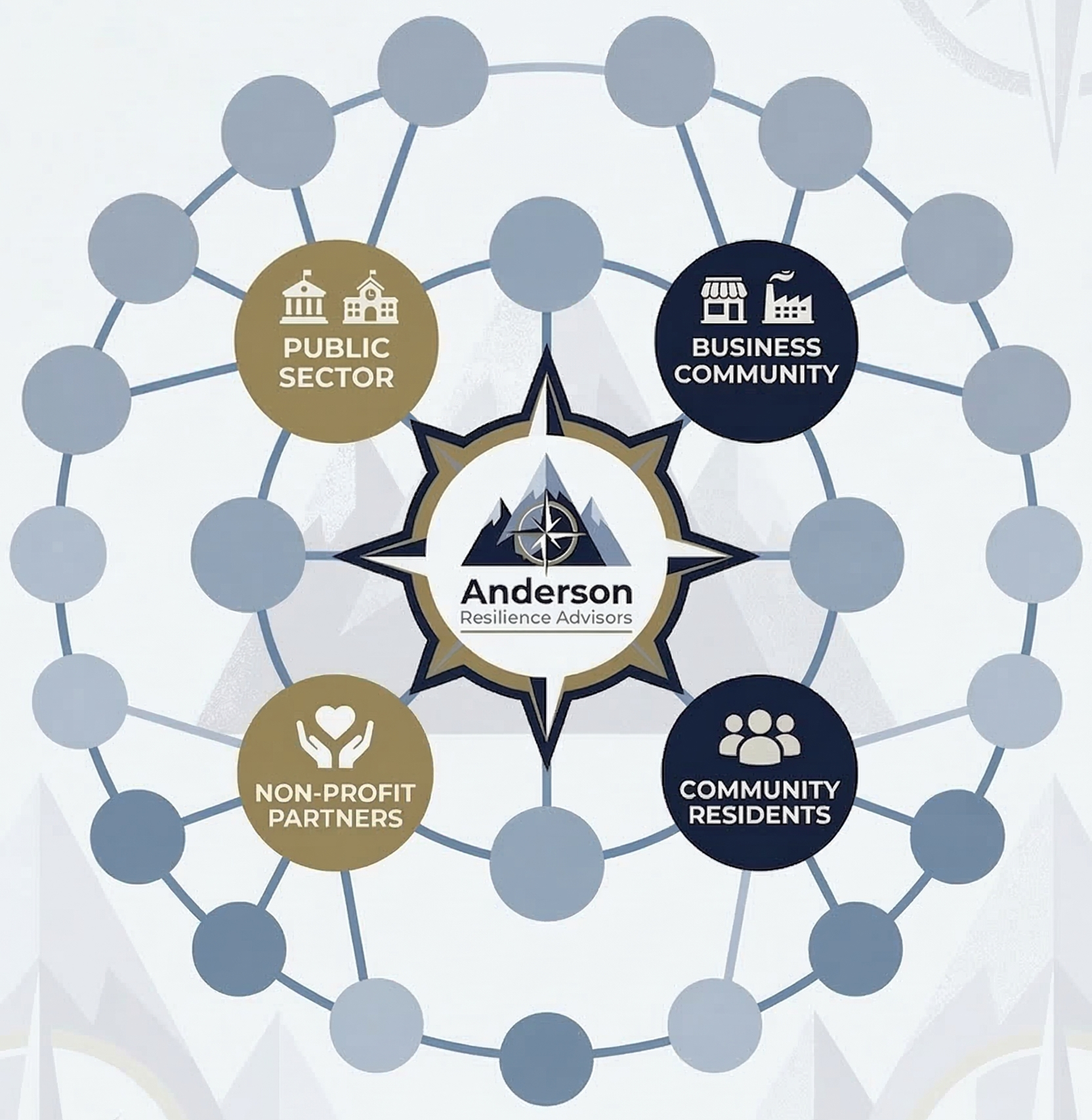
Resilience isn’t a department. It’s a network.
Most disaster planning focuses on "hardening" the physical world—adding fire-resistant building materials, reinforcing bridges, and upgrading power grids. While infrastructure is critical, social, organizational, and economic durability is the goal of community resilience.
At Anderson Resilience Advisors (ARA), we believe that real resilience lives in the connections between your departments, your businesses, and your people.
Moving Beyond the Silo
Small and medium-sized organizations often operate in isolation. In a crisis, these silos become points of failure. The ARA Approach breaks these silos. We facilitate the "Whole-of-Community" conversations that turn a collection of departments into a resilient network.
Ready to build resilience?
The Connected Community: Our Focus Areas
Economic Durability
Infrastructure is only as good as the economy it supports and resilience-building needs to ensure local commerce has the roadmap it needs to reopen and help stabilize the community.
Cross-Sector Integration
We facilitate planning sessions that bring together traditionally separate entities. By building these relationships before a disaster, we ensure that decision-making during a crisis is fluid, not fractured.
Social Resilience & Equity
Resilience that doesn't reach every neighborhood won’t help a community. We work to ensure the most vulnerable populations are not left behind.
Why It Works
Our strategy is led by Dr. Deserai Anderson, whose research in disaster policy shows that "right-sized" planning—based on real-world human behavior and local capacity—outperforms generic, template-based plans every time.
We don't give you a 400-page binder that sits on a shelf. We give you a Connected Community Strategy: a usable, living framework that empowers your leaders to act with confidence.